Tuesday, December 9, 2014

Need to look at release of undertrials'

Need to look at release of undertrials'

Shemin Joy, Dec 7, 2014, DHNS
Senior IPS officer V K Gupta is the Director - General of Uttar Pradesh Human Rights Commission. Gupta, who was Additional Director General (Prisons) in Uttar Pradesh between 2009 and 2012, spoke to Deccan Herald's Shemin Joy. Excerpts:
Senior IPS officer V K Gupta is the Director - General of Uttar Pradesh Human Rights Commission. Gupta, who was Additional Director General (Prisons) in Uttar Pradesh between 2009 and 2012, spoke to Deccan Herald’s Shemin Joy. Excerpts:

Overcrowding of jails is a concern area. What are the problems that led to such a situation?

There are several reasons for that. The power of the state to commute sentence is no more there, convictions have become faster and population is increasing. Earlier, people were periodically released on certain occasions like Independence Day and Republic Day. The power of governments in releasing people has been struck down by courts due to misuse by the State.

If you compare the figures of release of convicts in last 10 years with the release in the previous 10 years, you will find that the figures are negligible. Another issue is more people are indulging in crime. If you see evolution of crime, the bigger crimes have come down while the smaller crimes have grown in numbers.

Dacoity and all have come down but motorcycle theft, chain snatching and laptop lifting all have increased. I feel the poor people cannot afford quality lawyers. Many must be in jail even when they are not really culprits. Overcrowding is a problem.

The capacity of jails has increased by only 5,000 between 2012 and 2013 while the number of prisoners rose by 17,000.

The point is, after all, how much capacity can be increased. You cannot manage huge numbers in a jail. The prison population has to be manageable. Criminals are not bothered about discipline.

You cannot use force against them. In Uttar Pradesh, we have almost 90,000 prisoners in 73 jails. It is a huge number. Prisoners should have enough space for themselves. There should be a slab for them to sit. Now it is only a flat ground, you are lying down or squatting. These are creating problems in knee joints.

The Supreme Court has stepped in asking the Centre and states to decongest jails by releasing undertrial prisoners under certain conditions.

 That is very good. Just because we cannot complete trial, we cannot keep someone in jail forever. If someone is languishing in jail and if he is acquitted later, how will you return his time? The point is that the jail authorities cannot do much.

They have to report to the court that such and such prisoner has completed this much time and these are the charges and kindly release him. Jail authorities are only the custodians of the prisoners. The release order has to come from the judiciary. It is the bottleneck. There should be some system of auditing to see that such prisoners are not languished.

 In spite of all these measures, the impact is less. Re-arrest is a problem. Some times, habitual offenders are released from jail after their prison term and they are again arrested as preventive action. A common man may also languish in jail because of lack of legal aid. He may not have the resources to hire quality lawyers. After convictions, jails also help them with appeal. But that is a one-line appeal to higher courts. They may not get the required relief. This is also an issue.

You have been a jail administrator. What were the difficulties you faced?
A jail superintendent has to manage the jail. He cannot keep standing all the time in the court. He is summoned by the court in so many matters. Superintendents' work is to audit and make the report. The court should be efficient in disposing of these cases.

The government has now announced the next phase of modernisation of prisons.
In modernisation, the basic issue is to decongest jails, ensure hygiene and medical facilities and so on. One has to ensure that prisoners should have some work to do. They should be given education. They should be given an opportunity to appear in exams. We should involve local industries in ensuring that prisoners are getting some job while in jail. Give them training and raw material.

The prisoners can make the product and the local industries can pay them. Prisoners, who are languishing, will get some money.

 We need to plug loopholes to ensure that there is no corruption. The biggest source of corruption in jail is cooking. All the time, prisoners are cooking. Why not outsource cooking? When I talk about modernisation, I talk about modernisation of thoughts rather than modernisation of materials. One has to see how we modernise.

Modernisation does not mean that you buy more weapons. What will you do with the weapons in jail? You are not supposed to open fire in jail. We should use computers to shorten our paper work.

People’s tribunal throws new light on Sister Valsa John’s murder

People’s tribunal throws new light on Sister Valsa John’s murder

Author(s): 
Issue Date: 
2014-11-19
New report by tribunal comprising leading lawyers and researchers suggests the nun fighting for land rights of tribal people in Jharkhand was probably eliminated by hired killers, not Maoists as claimed by state police
Sister  
Valsa John was murdered three years ago by a mob of 20-25 persons. Her murder  
has been linked by the people's tribunal to a string of unaccounted murders  
of people's leaders fighting for land rights Sister Valsa John Malamel, a Christian nun working on tribal land rights in Pakur district of Jharkhand, was brutally murdered by a mob of 20 to 25 persons three years ago, on November 15, 2011. The nun from Kerala had been leading land protests against a mining company. The Jharkhand Police has so far been maintaining that she was murdered by Maoists because she had helped negotiate an agreement between Panem Mining Company and the project-affected villages and that the Maoists were opposed to any such agreement.
On October 14 this year, a Maoist who surrendered himself also reportedly told the police in Dumka that Sister Valsa was murdered by Maoists. Earlier, police had even arrested seven persons in connection with this murder.
But recent testimonies submitted to an independent people’s tribunal suggests that the murder was meant to weaken the land rights movement and that had the nun lived on she would have ensured strict implementation of the MoU signed between the villages and the mining company so that people get their due rights.
The tribunal’s report was released on November 16 by Delhi based non-profit The Research Collective, a part of Programme for Social Action. The report was prepared by the independent fact-finding tribunal comprising Supreme Court lawyer Prashant Bhushan, academic and researcher Bela Bhatia, academic from Ranchi University Ramesh Sharan and journalist Venkatesh Ramakrishnan.
String of unaccounted murders, accidents
The people’s tribunal has linked the nun’s murder to that of several other activists and farmers, who reportedly died under mysterious circumstances. All of them were working to ensure strict implementation of the MoU. (Among the slain, many were displaced by the mine and joined the movement against the mining company).
The independent  
fact-finding tribunal comprising Supreme Court lawyer Prashant Bhushan,  
academic and researcher Bela Bhatia, academic from Ranchi University Ramesh  
Sharan and journalist Venkatesh Ramakrishnan

When the panel started assessing the implementation of MoU earlier this year, they found that the mining company had hardly taken any step towards rehabilitation and resettlement of 4,000-odd displaced people. On top of this, several testimonies before the tribunal showed that with the loss of leaders in the movement, followed by cancellation of coal mines, resettlement and rehabilitation remains a far cry.
The report says the murders of leaders of Raj Mahal Pahad Bachao Andolan (RPBA) movement, a non-profit formed by the displaced people representing the nine project-affected villages, Sister Valsa and Joseph Soren coincided with the weakening of the people’s movement following which the MoU could not be properly implemented. “The phase post the signing of the MoU also saw the alleged murders of prominent Andolan leaders. While the murder of Sister Valsa on November 15, 2011 has received attention and is subjudice, village residents suggest that Joseph Soren was killed by Panem Company contractors. The same accident in which Soren died also left Cornelius Hembrom, the pradhan (Sarpanch) of Pachwara paralysed for life,” the report states.
Company hand?
According to Joseph’s brother, Kalam Soren, who deposed before the tribunal, Panem offered to pay for the education of Soren’s three children. “However, in 2009, my brother’s wife and nephew (Joseph’s son) died mysteriously in a car accident. Now I look after their two daughters. Even, Hembron’s son, Janus was crushed by coal carrying dumper earlier in 2007,” says Kalem, who lives in Alubera village.
As Jharkhand prepares for the Assembly polls in December, people displaced by coal mining in Pakur district have sounded an alarm over companies trying to make a hasty exit without honoring the agreements signed with the locals following the cancellation of allotments by Supreme Court. The Panchwara coal mines, mined by Panem Mining Company, a joint venture of Punjab State Electricity Board (PSEB) and Eastern Minerals and Trading Agency (EMTA), a Kolkata-based mining company, was one of the first cases in which villages agreed to sign a MoU directly with the company instead of opposing it.
Panem violated laws protecting tribal rights
After displacing about 4,200 persons from nine villages, mostly belonging to Santhal tribe, and filing of cases in both Supreme Court and high court, the company signed the MoU with RPBA. Being in the heart of the Santhal-dominated Pakur district, the lands are protected by Panchayat (Extension to Scheduled Areas) or PESA Act  and Santhal Parganas Tenancy Act. Both the Acts are meant protect the land rights of tribals and also have strict regulations for land diversions for any industrial activity. Residents claim that both these Acts were violated by the mining company which went on to acquire the land, even as the high court dismissed the case stating no violations had happened.
People of nine  
villages, who are affected by Panem's mining, gave their testimonies to the  
tribunal

Interestingly, as soon as the residents represented by RPBA approached Supreme Court, the mining company, aided by the state government, offered an out-of-court settlement of sorts, by instituting an MoU.
Incidentally, in 2012, many big leaders of Jharkhand, including former Chief Minister Shibhu Soren, the then Deputy Chief Minister Stephen Marandi went on a two week agitation against slow implementation of the MoU.
Around 807 households, comprising a population of 4,207 people from nine villages, which fell within the core zone, were to be displaced for the mine, according to the report. The land acquired included forest land of about 461.09 hectares as well as revenue land measuring about 672 hectares, homestead and agricultural land of about 674.20 hectares. The MoU guaranteed many things: Panem would return 50 per cent of the land acquired from project affected persons in cultivable condition; livelihood compensation of Rs.10,000 per acre per year until land (50 per cent) is returned to the project affected; homestead land with customary houses; compensation for land as per Land Acquisition Act 1894; direct employment to families; provision of drinking water; no disturbance of traditional worship spaces, conversion of non-cultivable land in the surrounding area into cultivable land; lift irrigation system; new school and hospital; regular training for women and men; provision of tractors; market places; and ambulances.
Who will restore people’s land rights?
However, besides giving some part of the compensation and some building of infrastructure, no other provision of the agreement has been fulfilled, according to this report. The panel claims that the current status of implementation of the MoU is evidenced through the testimonies and depositions in the tribunal. Activists say that the official papers of the implementation for a comprehensive review were not available as it is in the custody of the local police. The district administration, meanwhile, says that implementation may have been slow but has been carried out by the mining companies.
A testimony before the tribunal belies government claims. “I was convinced right from the beginning that I had to oppose the mining of coal by Panem. If Panem digs up all our lands, what is to happen to my children and what will they eat? The company bought over our villagers and broke our unity. We agreed to settle with the MoU only because it promised to return our lands. Since the settlement things have only gotten worse for us. The mine has not been refilled properly, our lands have not been returned to us. We have not even been given ownership rights for the house we are living in now. Also, most other provisions of the MoU have not been implemented properly,” stated Chandmuni Murmu of New Kathaldih resettlement colony, who deposed before the tribunal. About 150 village residents attending the meeting said that the damage to the trees have never been accounted for by the government or mining companies, nor did anyone compensate them.
Now, as government plans to auction all these coal blocks following the Supreme Court’s cancellation of all the coal blocks, including ones in Panchwara, the independent panel has demanded that the land should be given back to the villages. “In context of the Supreme Court de-allocating both the Pachwara Central Block (allotted to Panem) and the Pachwara North Block (allotted to EMTA), as well as the fact that the MoU has been breached in most aspects by the company, the government should not auction the coal mines in Pachwara and return land to original villagers after making it cultivable,” said Prashant Bhushan. Incidentally, according to the coal ministry the proposed auction of 204 coal blocks will fetch huge revenues to exchequers of states, particularly Jharkhand, which will get Rs 2.5-3 lakh crore in the next 30 years.
 

Police went on rampage in Chhattisgarh villages, say residents

Police went on rampage in Chhattisgarh villages, say residents

Pavan Dahat
An injured villager. Photo: Pavan Dahat
The Hindu
An injured villager. Photo: Pavan Dahat

Reprisal for protest against ‘illegal detention’ of woman, say residents

For almost a week now, Bhime Kawasi (45), a resident of Chota Tongpal village in Sukma district of South Chhattisgarh is being fed by her neighbours.
“Police personnel beat me up with the gun-butts when I tried to stop them from detaining my brother” claimed Bhime showing the plaster on her hands and legs.
According to the villagers of Chota Tongpal, Jangampal and Bade Gurbe, which fall under the jurisdiction of the Kukanar police station, over 150 police personnel entered their villages, ransacked their houses and detained 26 villagers.
“When we tried to protest, they [security personnel] attacked us including the women and children,” said Mose, a resident of Jangampal village claiming that she was also stripped and beaten up.
Villagers allege that the “police attacks” were in response to a protest, which the people of these three villages launched against the alleged illegal detention of Sukadi Mandavi of Bade Gurbe village on November 20.
“Police wanted to arrest and implicate me in some Maoist violence cases, but I was not at home so they picked up my wife,” Sukadi’s husband Ayata Mandavi told The Hindu.
Ayata also claimed that he had no contact with the Maoists and that Bastar range Inspector General (IG) SRP Kalluri was threatening him.
Sukadi was let off after continuous protests for three days by the villagers who had surrounded Kukanar police station. “But then the villagers were subjected to inhuman treatment because they protested against the illegal police action. Out of 26 villagers detained by the police, 11 were released, but 15 have been implicated in Maoist-related offences and have been sent to Dantewada jail. Over 12 women have suffered fractures,” claimed Jangampal Sarpanch Mudakram Sodi.
Ayata said that he had not been able to stay in his house in Bade Gurbe due to the “fear” of police.
“Now even the villagers have started saying that I should leave the village because they are being subjected to inhuman torture,” Ayata said. Sukma Superintendent of Police (SP) D. Srawan, however, refuted the allegations levelled by the villagers.
“Sukadi was never with the police. We received a missing complaint and she was traced near Sukma and handed over to her family. As for the villagers’ claims of atrocities, an additional SP is investigating them. The 15 people were arrested for ransacking some vehicles during the Maoist bandh on November 8,” Mr. Srawan told The Hindu

Violence Against Churches And Personnel In India

Violence Against Churches And Personnel In India
By Concerned Citizens
04 December, 2014
Countercurrents.org
TEXT OF MEMORANDUM TO PRIME MINISTER, HOME MINISTER OF INDIA AND LET. GOVERNOR OF DELHI
2nd December 2014

It is with a heavy heart and great concern that we address this memorandum to you to bring to your attention incidents of violence against our Churches and personnel in the country, the latest of which is the arson in the Catholic Archdiocese of Delhi’s St Sebastian’s Church in Dlishad Garden, East Delhi in the early hours of 1st December 2014.
The gutting of the St. Sebastian’s Church, as well as the other incidents of targeted violence in other parts of the country, speak of extreme police and administrative impunity and disregard not only to the sentiments and injured religious feelings of our community but also the guarantees of the Constitution of India. Delhi is governed directly by the Union Government’s Ministry of Home Affairs which makes it all the more serious.
1. We call upon you to order an immediate judicial enquiry by at least a High court serving or retired judge to ascertain the facts of this malicious act and the circumstances surrounding the polarisation that is taking place.
2. We also request you to ensure that the Delhi administration repairs the entirely gutted church so that the faithful of the capital region can celebrate the Christmas Midnight Mass prayer service on the night of 24th December 2014.
3. It is a matter of deep regret that the local police officers paid little heed to our repeated requests that the scene of the crime be investigated properly. No senior officer visited the spot till late in the afternoon, and the forensic team came only by the evening. In addition to the judicial enquiry, an internal departmental enquiry also must be ordered to identify officers and men guilty of dereliction of duty.
4. We are confident that you will ensure that the guilty are traced by the police at the earliest and charges brought against them for arson, hurting the religious sentiments of the Christian community and for attempts to create religious discord.
The details of the arson in the St. Sebastian’s Church, Dilshad Garden, East Delhi, and incidents in other parts of the country are as follows;
St. Sebastian’s Church in Dilshad Garden was constructed in 2001 and is among the biggest churches in the area. The fire was reported early this morning. The entire interior, including the Altar, the Holy Bible and Cross were reduced to ashes.
On the complaint of Church priest Fr. Anthony Francis, the police have registered an FIR against unknown outsiders for causing the fire with malicious intent. Senior officers of Delhi police, the Special Branch and the Forensic Crime unit came to the spot after many hours, and once the agitated members of the Catholic community blocked the roads in the area. Samples were retrieved from the inside of the church, which still smelt of fuel oil.
Till late in the evening, police could not say they had made any progress in their investigations.
Addressing the media, Archbishop Couto said apart from the judicial enquiry, the government must repair the building before Christmas, ensure that policemen guilty of dereliction of duty are punished, and special police investigation teams are set up to trace the guilty.
II. In Madhya Pradesh
On Sunday, 30th November 2014, two house churches in Annupur district of Madhya Pradesh were attacked.
III. Chhattisgarh:
Chhattisgarh has particularly witnessed regular and repeated attacks on the fundamental rights of the minority Christian community. Most recently, according to the media and local sources, local politico organisations such as the VHP are pressurising local Catholic missionaries to put up pictures of Goddess Saraswati in their educational institutions. The Catholic schools are also under pressure to rename the principals in their schools, as “Pracharya”, or “Up-pracharya”, instead of the term “Father”, which is usually used.
Some of the other incidents briefly outlined below are representative the hostility and discrimination being faced by Christians across India.
1. Social Boycott
• The entry of and propaganda by non-Hindu missionaries, especially Christians, is banned in more than 50 villages of Chhattisgarh’s Bastar region by the local gram panchayats since late May.
• In Deggarh district, Odisha several tribal Christian families were excommunicated on 28 April allegedly at the behest of religious extremists. The three Christian families were excommunicated and deprived from enjoying common facilities of the village road, water and forest land because of their faith in Christ. The well commonly used by the Christians was polluted by adding filth to it. And the Christians have been forbidden to mix or talk to anybody, to take part in any social functions or walk on the main road. The extremists also threatened to snatch away the Govt. land allotted to the Christians, to cancelled their BPL Cards and demolished their houses if they do not renounce Christ.
2. Physical Assaults
• On 16 June, a mob of religious extremists brutally beat up Christians and 10 believers including two women who were later rushed to the hospital in Sirisguda, Bastar town, Jagdalpur, Chhattisgarh. About 100 Christians who were denied rations for two months for their faith in Christ were beaten up by a mob. At about 1 pm, Christians from 52 families came together before the district Food Inspector office when the mob rushed in and started to beat the Christians indiscriminately. The mob beat up the Christians with sticks, kicked and punched them and hurled stones at those who were trying to escape from the scene. Two women were pulled to the ground while the perpetrators stood on them and hit their genital organs. No FIR was registered against members of the mob.
• Religious-political extremists locked up a church on June 5 after they beat up a Christian family in Balwanazir, Kaliyanganj, Bihar. The mob comprising of beat up Sadanandan Singh and his family for their faith in Christ on May and June and finally locked up the church of the Indian Evangelical Team. Singh and his family were dragged on the road and the entire family including two minor girls were beaten up mercilessly. The extremists have locked up the church and told Singh that he is not allowed to pray in the future in the village.
3. Desecration of and Restrictions on House Churches or Building Churches.
• Local religious political groups threatened to harm Pastor Bhikanlal Dhurvey several times for conducting prayer meetings in Bhopal, Madhya Pradesh. However, the pastor continued to conduct worship services and later started to build a prayer hall in his land. Subsequently, the extremists filed a police complaint against the pastor of illegal construction. The construction has since been stopped and prayers are now being conducted in the homes of local Christians
• On 18th May in Kundupur, Karnataka the properties of two churches were allegedly damaged by unidentified miscreants. An ornamental pot at the entrance of the Holy Rosary church was broken and a signpost leading to St. Antony Church in Koteshwar also was uprooted.
• On 29 April, three chapels in Irinjalakuda diocese were damaged after allegedly police cleared the way for the "Way of the Cross' procession of the Saint Anthony's Catholic Church. Earlier on 11 April, extremists had blocked the procession of St Antony's Catholic Church. The police intervened and cleared the passage for the procession as this was the traditional practise for several years and the local temple administration has given permission for the same.
India is a land where different religious faiths have long since flourished and our founding father made special efforts to ensure that the rights of all are safeguarded irrespective of our religious beliefs, gender or caste. India is committed to secularism and any attempt to weaken the socio-religious fabric of the nation must be dealt with swiftly and effective.
We hope and pray that such discrimination and targeted violence will be ended by strong political will and administrative action.
You and your government are poised in a unique moment in the history of the nation to ensure that all people, irrespective of faith, feel secure. Small religious communities such as the Christians need to be reassured they are protected and are secure and safe in their motherland.
We continue to pray for you and the government. We pray for India and for the welfare of all its people.
For further information, please contact: Fr. Savarimuthu, 09968006616, frsankar@gmail.com, Dr. John Dayal, 09811021072,john.dayal@gmail.com and Fr. Stanley 09910504011,frstanley@gmail.com

We are shown as surrendered Maoists: Sukma villagers

We are shown as surrendered Maoists: Sukma villagers

The Hindu
Dec 8,2014
Pavan Dahat
 

Many say they have no link or stopped working for the ultras long ago

Madkam Panda (27), a farmer from Chichurguda village in Sukma district of South Chhattisgarh, is leading a normal life though his village falls in an area known for Maoist violence.
Panda is one of the “rewarded Maoists” who recently surrendered before police in Bastar region of Chhattisgarh.
“I never had any kind of relationship or contact with the Maoists. A few months ago, I received a communication from the nearest police station that my name has figured in the list of suspected Maoists. I was asked to be present in Sukma district police headquarters,” Madkam Panda told The Hindu, adding that during the days of Salwa Judum he had worked as a Special Police Officer (SPO) for three years.
“I was told that they will remove my name from the list of suspected Maoists if I agree to pose as a surrendered Maoist. They [police] made me sign on a paper, put a cloth around my face and paraded me before the media as a surrendered Maoist,” claimed Panda.
Atul Sodi, another villager of Chichurguda who was shown as a surrendered Maoist by the Sukma police, narrated the same story.
“We were asked to go back to our village without any financial assistance,” claimed Sodi.
According to villagers of Chichurguda, Misma and Pinnabhejji village, around 47 people from their area have been asked to surrender in a similar fashion and many of them had either no link with them or stopped working for the Maoists years ago.

70% Chhattisgarh Naxal surrenders are neither ‘Naxal’ nor ‘surrenders’

70% Chhattisgarh Naxal surrenders are neither ‘Naxal’ nor ‘surrenders’

Mother, sister of ‘surrendered Naxal’ Kartam Mukka, in Samsetti village of Sukma. They are surprised at claim.

Written by Ashutosh Bhardwaj | Bastar/ Raipur | Posted: December 8, 2014 3:46 am | Updated: December 8, 2014 8:28 am

Chitu Sori of Kodenar village in Kondagaon district is a farmer. On June 26, police declared that the 25-year-old had “surrendered” with several fellow villagers. This was the beginning of an unprecedented run of “surrenders” by Maoists in Chhattisgarh this year. In his records, however, Sori is merely shown to have provided occasional help to Maoists. He returned to his village after the “surrender” and continues living there.
Among the residents of Atulpara village in Sukma who “surrendered” on August 19 were Barse Deva, Madkam Deva and Podiyam Deva. Like many tribals of Bastar, they had long-pending warrants against them, with police often booking villagers in bulk on any suspicion. These warrants were never executed, but this year, the three say, police proposed that if they “surrendered”, the warrants would be withdrawn.
A resident of Chingnar village of Narayanpur, Dayaram Nag provided rations occasionally to Maoists. On September 14, he was among those who “surrendered”.
naxal_embChaitram Salam had worked with the Maoists for some years but for a while now had been living in Narayanpur, when police asked him to “surrender” on August 25 in lieu of some benefits.
Going by the Chhattisgarh Police’s records, none of the above cases from Bastar is eligible to be called a “surrendered Maoist”. They are not alone.
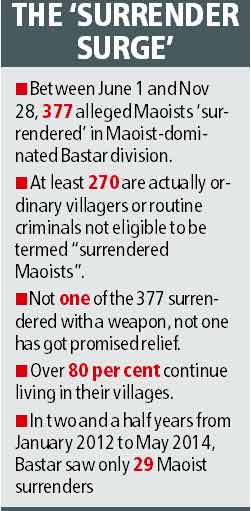
Between June 1 and November 28, a total of 377 alleged Maoists are reported to have surrendered in the Maoist-dominated Bastar division, 155 in November alone. A scrutiny of police records and meetings with these “surrendered” Maoists show that at least 270 of the 377 are actually ordinary villagers or routine criminals not eligible to be termed “surrendered Maoists”.
Not one of the 377 surrendered with a weapon, and no one has got the post-surrender relief or rehabilitation. Over 80 per cent of those who surrendered continue living in their villages, the remaining ones in police camps.
In contrast, in the two and a half years from January 2012 to May 2014, the seven districts of Bastar saw only 29 Maoist surrenders.
A week before the deadliest attack on the CRPF in four years by Naxals, in Chhattisgarh’s Sukma district, the Union Home Ministry cited record surrenders in the state as a measure of its successful anti-Maoist policy. On November 26, the state saw the surrender of 63 more such alleged Maoists, the biggest ever in one go.
Bastar IG S R P Kalluri, whose tenure beginning June 10 has seen a surge in surrenders, says he is “not concerned about the eligibility criteria or the surrender policy”. It is a “new strategy for winning an ideological war against Maoists”, he asserts. By wooing tribals through surrenders, police can break the first line of Maoist defence, Kalluri says.
“Earlier anti-Maoism meant mark area and go for police operations… I have dispatched hundreds of letters in interior villages urging people to join us. People are coming from across rivers. If they want to embrace democracy, should I embrace them or insult them by saying you are not eligible for surrender?” he says.
About why police let them return to their villages though Maoists could target them, Kalluri says: “We give them a choice. Bastar tribal is a free-spirited person, he enjoys forests and rivers and is not interested in your surrender policy.”
Significantly, even the Home Department of Chhattisgarh doesn’t appear comfortable with these numbers. A letter sent to DGP A N Upadhyaya and all police superintendents on August 20 cautioned that “the police should focus on the surrender of important cadres instead of lower-rung cadres”.
Earlier, on January 10, then Chhattisgarh DGP Ramniwas had written to all IGs and SPs asking them to avoid the hype around non-deserving surrenders, saying it “confused our ground police personnel to bear wrong priorities” and “disorients” them from their focus.
While the district police can present anyone as a surrendered Naxal, a committee at the Raipur Police Headquarters headed by the ADG (Special Intel Bureau) is meant to scrutinise every case and to decide the rehabilitation package.
“We can take action against Maoist supporters depending on the nature of support they provided but only a person who was an active member of any banned organisation at the time of surrender should be considered eligible for surrender,” says ADG (SIB) R K Vij. “We are scrutinising the cases.”
The 377 surrendered persons fall under four broad categories:
a) “Naxali sahayogis” or people who have occasionally helped the rebels, by choice or force, with rations or shelter. So far, the police would detain such villagers and release them after interrogation.
IG Kalluri defends: “Imagine a boy of an interior village who has performed an occasional task of courier or sentry for the Maoists. If this boy wants to surrender, should I say that you are not a cadre or should I appreciate that he is impressed by democracy?”
b) People with warrants, who are pressured to surrender as a quid pro quo for withdrawal of cases. Only courts have the authority to withdraw criminal cases but, says Kalluri, “I tell them I am duty bound to send you before court and put you in jail. If I have to let you free, the only alternative is to show you as a surrendered Maoist. I use my judgment.”
Admits ADG Vij, “It is not within the jurisdiction of a police officer to withdraw warrants.”
c) Former Maoists, who left the rebel camp long ago and are now leading a family life.
d) Active Maoists or those belonging to banned front outfits. Under the policy, only they are eligible for surrender, and they make up the smallest number among all the four categories.
Argues Kalluri, “By surrenders Maoists develop a sense of belonging with police. Others will follow their example, we will get bigger cadres.”
However, contrary to what the IG says, branding ordinary villagers Naxal may neither benefit them nor may be necessary. While it leaves them open to future harassment, there are several schemes for tribal welfare that can also help bring them into the “mainstream”.
A surrendered Naxal is entitled to an “immediate grant” of at least Rs 1.5 lakh by the Centre and Rs 1 lakh by the state, “a monthly stipend of Rs 4,000 for maximum 36 months”, besides cash award between Rs 1 lakh and Rs 1 crore depending on his or her designation. However, only around 100 persons have received “relief” so far, that too just Rs 2,000-Rs 5,000 as “Protsahan Rashi (encouragement amount)”. Less than 10 have got Class IV jobs.
Kalluri agrees this could discourage other Maoists seeking to surrender. “It is up to the government to take ten steps,” he says. “Maoists go to Andhra Pradesh after surrender as they are treated there like kings.”
None of the 136 Maoists to have surrendered in Chhattisgarh from January 2009 to May 2014 has received any benefits either.
In a statement last week, the spokesperson of the Dandakaranya Special Zonal Committee of Maoists, Gudsa Usendi, accused the Chhattisgarh police of “big fraud” in the name of Naxal surrenders, saying they pocketed the entire reward amount.

Old, old war

Old, old war

Each side claims that history is on their side, and while the government may have more reasons to back its claim, the Maoists can also point to the fact that guerilla struggles can last for a long time as in Colombia or Kashmir.  (Source: Reuters) 


Each side claims that history is on their side, and while the government may have more reasons to back its claim, the Maoists can also point to the fact that guerilla struggles can last for a long time as in Colombia or Kashmir. (Source: Reuters)
Written by Nandini Sundar | Posted: December 9, 2014 2:19 am | Updated: December 9, 2014 5:11 pm
more have been killed since. Vij notes that in 2005 the Maoists had only one military company; by 2010 they had 10. Where did all the recruits for these companies come from, if not from people whose homes had been burnt and relatives killed or raped? This is a fact that both the Intelligence Bureau and the Maoists themselves have acknowledged in the past. And yet, Vij coyly refers to the Judum as a revolt by the population of western Bastar against the Maoists.
The Chhattisgarh government had a golden opportunity to address the conflict through non-military means by simply following the Supreme Court’s orders on disbanding the SPOs, prosecuting those responsible for heinous crimes and giving compensation to all those affected by the Salwa Judum. But they chose not to do any of this. Instead, they regularised the SPOs, brought in more CRPF camps, and continued to beat up, torture and arrest villagers. They have converted the whole area into a garrison state. The outgoing CRPF director, Dilip Trivedi, was absolutely right when he said that Naxal-affected states have a vested interest in letting the war continue because of the massive funds they get from the Centre.
Each side claims that history is on their side, and while the government may have more reasons to back its claim, the Maoists can also point to the fact that guerilla struggles can last for a long time as in Colombia or Kashmir. While the government has more or less succeeded in hemming the Maoists into Chhattisgarh, a struggle whose basic causes are not addressed is never finished. If the Modi government succeeds in its decimation of environmental regulation and its mining cum industrialisation policy, Bastar as we know it will be finished. But there will also be a mass of displaced villagers angry at the acquisition of their land. And who knows where their anger will turn?
The government is unwilling to talk peace, because it feels it is winning overall. In the past, the police have refused talks on the grounds that it would give the Maoists time to regroup. The Maoists may be more ready for talks now, but to lay down their weapons unconditionally will be seen as unthinkable surrender. A sensible government would chose this moment to offer a ceasefire, since it is clearly the stronger partner. While the police may claim the Maoists’ ultimate aim is to claim Delhi, they know, and the Maoists know, this will never happen. The real issues are Adivasi rights, and they both know it. And it is these that must form the basis of dialogue.
In the absence of talks, this senseless civil war will continue indefinitely. After all, it will soon be 50 years since Naxalbari began. As Bob Dylan sang: How many deaths will it take till [we know] that too many people have died?
The writer is professor of sociology at Delhi